
How we work: facts are checked against original sources and linked, cruise prices are verified on the cruise line’s own website the day we publish, and we earn no commissions. Spotted a mistake? Tell us and we will correct it.
In July 1952, the SS United States crossed the Atlantic faster than any passenger ship before her. She has never been beaten.
Seventy-four years later, she has no funnels and no home. She lost a rent dispute, failed to leave Philadelphia four times, and has spent 19 months tied up in Alabama waiting for paperwork.
Next month, if the weather behaves, a Florida county plans to cut holes in her hull and let her sink to the bottom of the Gulf.
The fastest ocean liner ever built is about to become a fishing spot. Here’s how she got there, and the court order that started it.
What’s Happening: A Sinking Date, Weather Permitting
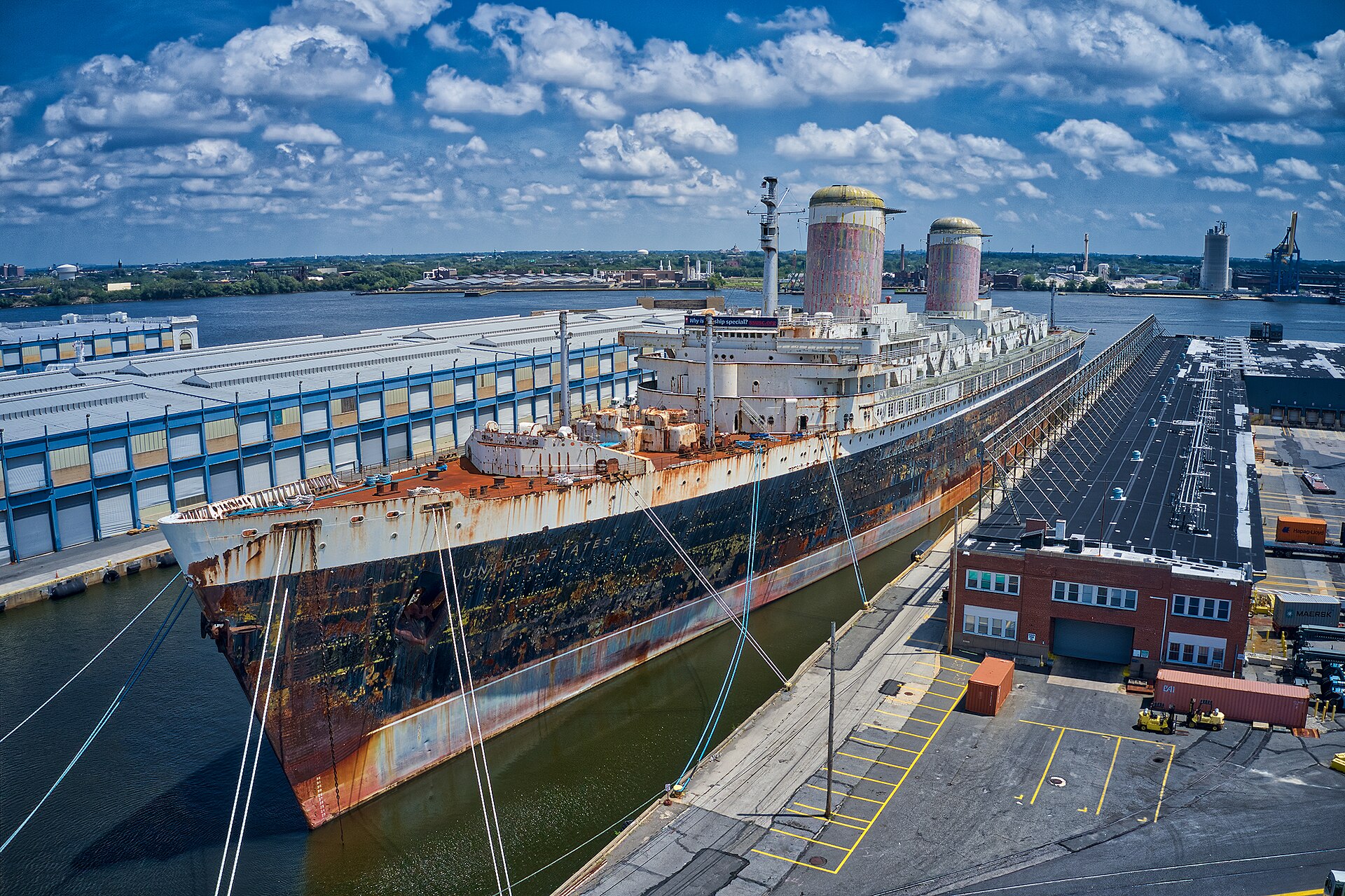
Okaloosa County, Florida, which owns the ship, says she will be deployed “about 22 NM southwest of Destin-Fort Walton Beach, the second week of November 2026.” The county adds that the operation is weather-dependent and the dates may change. Its announcement, republished by the Destin Chamber, says the ship is “one step closer to becoming the World’s Largest Artificial Reef.”
🎁 Free: the Cruise Survival Kit
A printable packing checklist and a money-saving cheat sheet, sent to your inbox straight away. Plus the week's best cruise stories and verified deals every Friday.
Send me the free kit →The county first posted the news on Facebook on October 9, FOX10 reported, calling it “an exciting move forward to create a one-of-a-kind resource for the environment and for our tourism industry.” County spokesman Nick Tomecek gave Professional Mariner the same lines. Cruise Fever picked the story up today.
The SS United States Conservancy, the nonprofit that owned her before the county did, confirmed the timeline on October 10. It says the ship has been in Mobile, Alabama, since March 2025, being stripped and prepared. Details of how the public can follow the sinking “in person or online” are still to come.
The Ship: Faster Than Anything Since
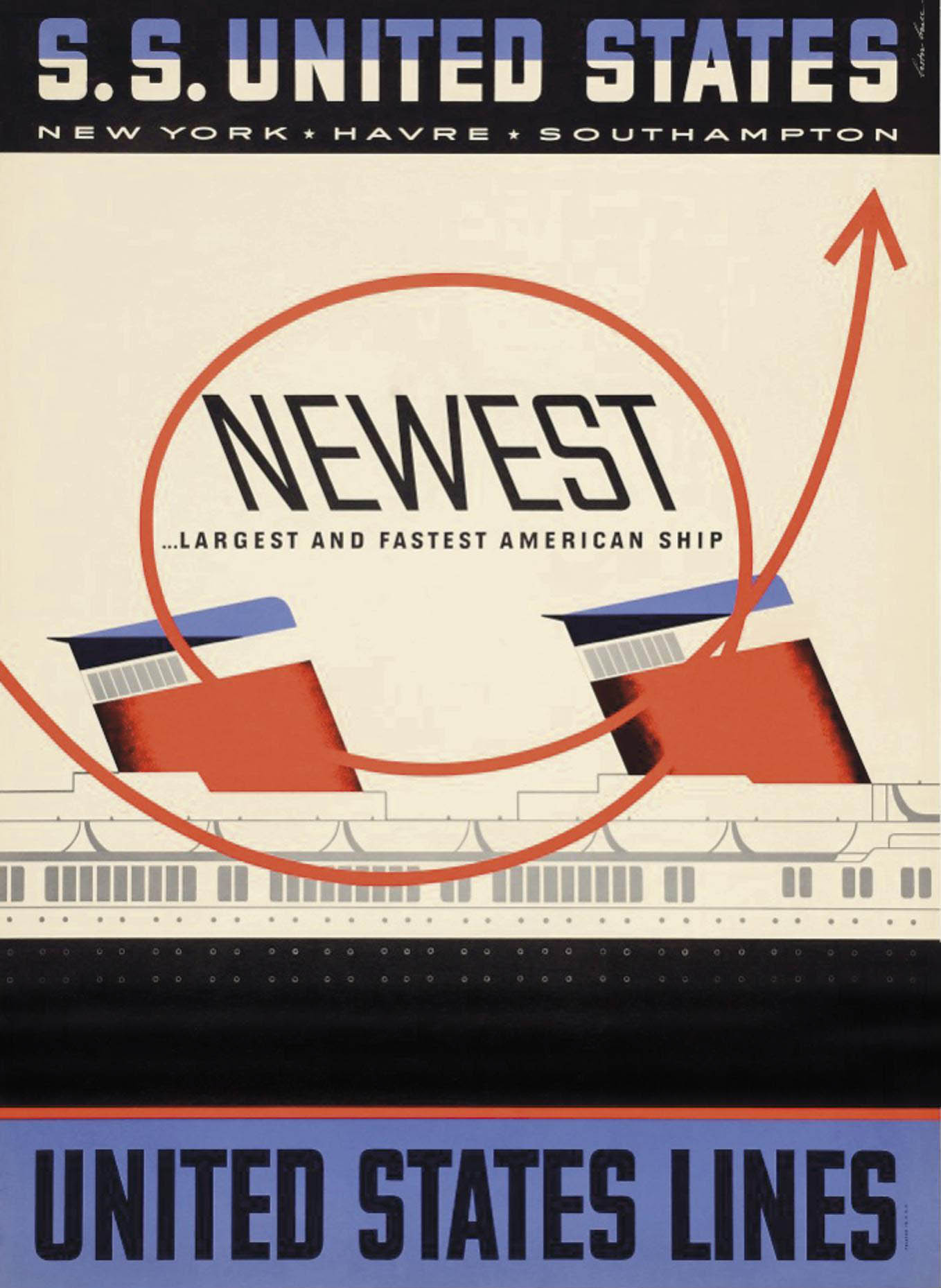
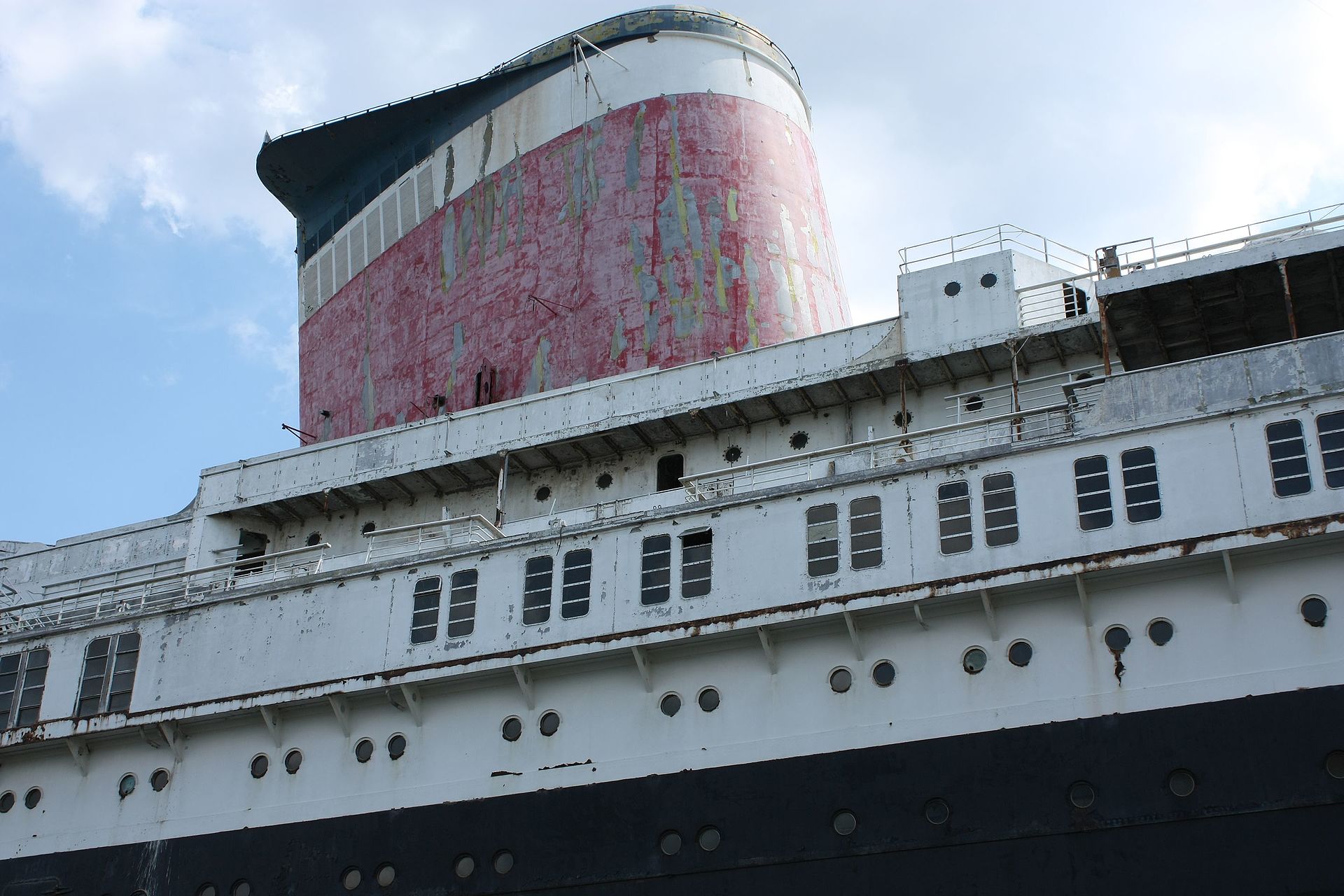
She was built at Newport News, Virginia, and is 990 feet long, about 100 feet longer than the Titanic, according to the Conservancy. On her maiden voyage in July 1952 she crossed eastbound in 3 days, 10 hours and 40 minutes, averaging 35.59 knots. That beat the Queen Mary’s record by more than 10 hours. She took the westbound record on the way home too (Wikipedia’s ship history has both crossings). The Conservancy says she still holds the transatlantic Blue Riband in both directions.
She was retired in 1969 and, after years of changing hands, was towed to Pier 82 on Philadelphia’s Delaware River in 1996, Get The Coast notes. She stayed there for nearly 29 years.
Cruise lines did try. In 2016 Crystal Cruises took an option to bring her back as a cruise ship. Six months later Crystal said the “costs and technical challenges” were “insurmountable” and donated $350,000 to the preservation effort instead, as Cruise Fever recalls and Wikipedia confirms.
The Rent Fight That Sank Her
Here’s where it turns into chaos. Pier 82 belongs to a company called Penn Warehousing & Distribution. Under a 2011 agreement, the Conservancy paid $850 a day to keep the ship there. In August 2021 the landlord doubled it to $1,700, on 14 days’ notice. The Conservancy kept paying $850. Both sides went to court.
The judge’s opinion, filed in the U.S. District Court for the Eastern District of Pennsylvania on June 14, 2024, mostly backed the Conservancy on the money:
“PWD’s unilateral demand for increased dockage fees beginning in August 2021, with 14 days’ notice, finds no support in the Berthing Agreement or contract law.”
Judge Anita B. Brody, Penn Warehousing & Distribution v. SS United States Conservancy, No. 22-2285 (E.D. Pa.), Memorandum Opinion
So the Conservancy didn’t owe the higher rent. But it lost the bigger point. The 2011 agreement had no end date, so the court presumed it was “terminable at will with reasonable notice,” and the landlord had given that notice. The final order, the same day, was one sentence long where it mattered:
“Defendant SS United States Conservancy must remove the SS United States from its berth at Pier 82 of the Port of Philadelphia no later than September 12, 2024.”
Final Order and Judgment, June 14, 2024 (PDF)
Won the rent argument, lost the parking spot. Professional Mariner reported at the time that the Conservancy’s president, Susan Gibbs, said the ruling gave it “a very limited window.” Finding a 990-foot berth in 90 days is not easy. In October 2024 Okaloosa County bought the ship for $1 million, with a plan to sink her as a reef (Billy Penn, Baird Maritime).
The Long Goodbye, Date by Date
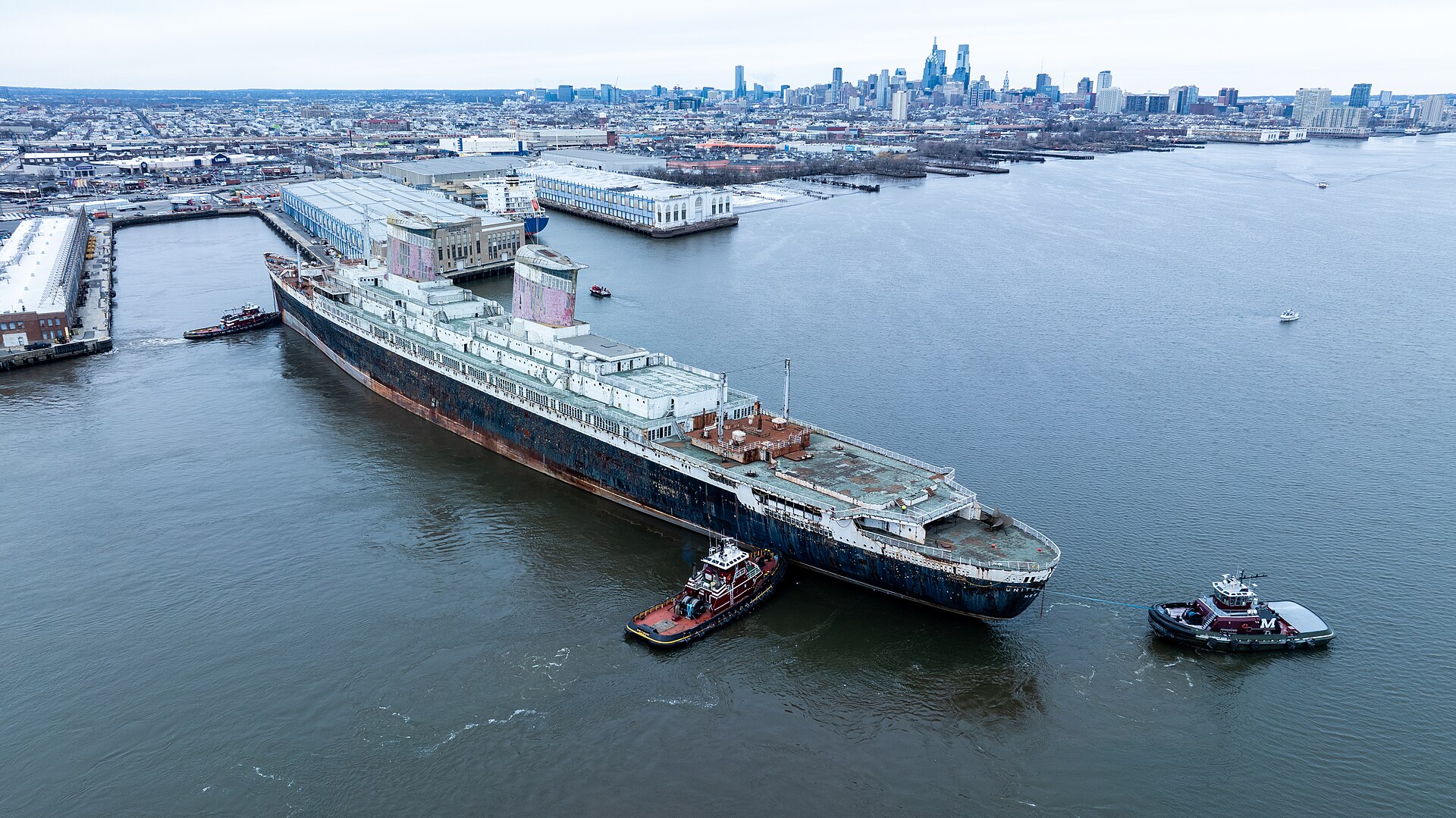
Leaving turned out to be harder than losing in court. Here’s every step since the ruling, with who reported it.
| Date | What happened | Reported by |
|---|---|---|
| June 14, 2024 | Court orders the ship off Pier 82 by September 12 | Court order; Professional Mariner |
| October 2024 | Okaloosa County buys her for $1 million | Billy Penn; Baird Maritime |
| Mid-November 2024 | First move postponed hours before it was due to start | Billy Penn |
| February 6-8, 2025 | Coast Guard holds the tow until it is sure the ship can be moved safely between piers; the February 8 departure is called off | WMBB (via Yahoo); Billy Penn |
| February 17, 2025 | Departure pushed again by a high wind advisory | Billy Penn |
| February 19, 2025 | She finally leaves Philadelphia behind tugs | Billy Penn; Wikipedia |
| Early March 2025 | Arrives in Mobile after a tow of about 1,600 miles and about 12 days | Get The Coast; SS United States Conservancy |
| August 2025 | Both 65-foot funnels and the radar mast removed for a museum | Wikipedia; Get The Coast |
| April 17, 2026 | Sinking, planned for May, slips to June while Army Corps of Engineers and EPA reviews finish | WEAR |
| Late September 2026 | County says the last hurdle is Army Corps sign-off | FOX10 |
| October 9-10, 2026 | County sets “the second week of November 2026” | FOX10; Conservancy; Destin Chamber |
Billy Penn counted the February 19 departure as the fourth time the date moved. The ship had to leave on a low tide: the outlet reported as little as six feet of clearance under the Walt Whitman Bridge.
The waiting has cost money too. FOX10 reported in September that county commissioners approved another $1.2 million, of which $944,000 was set aside to keep the ship docked in Mobile if needed. An AP report from November 2025, carried by WHYY, put the county’s whole plan at $10.1 million to buy, move, clean and sink her, including $1 million for an onshore museum, with $1.5 million from Pensacola’s tourism officials and $500,000 from Coastal Conservation Association Florida.
How Do You Sink a 990-Foot Liner on Purpose?
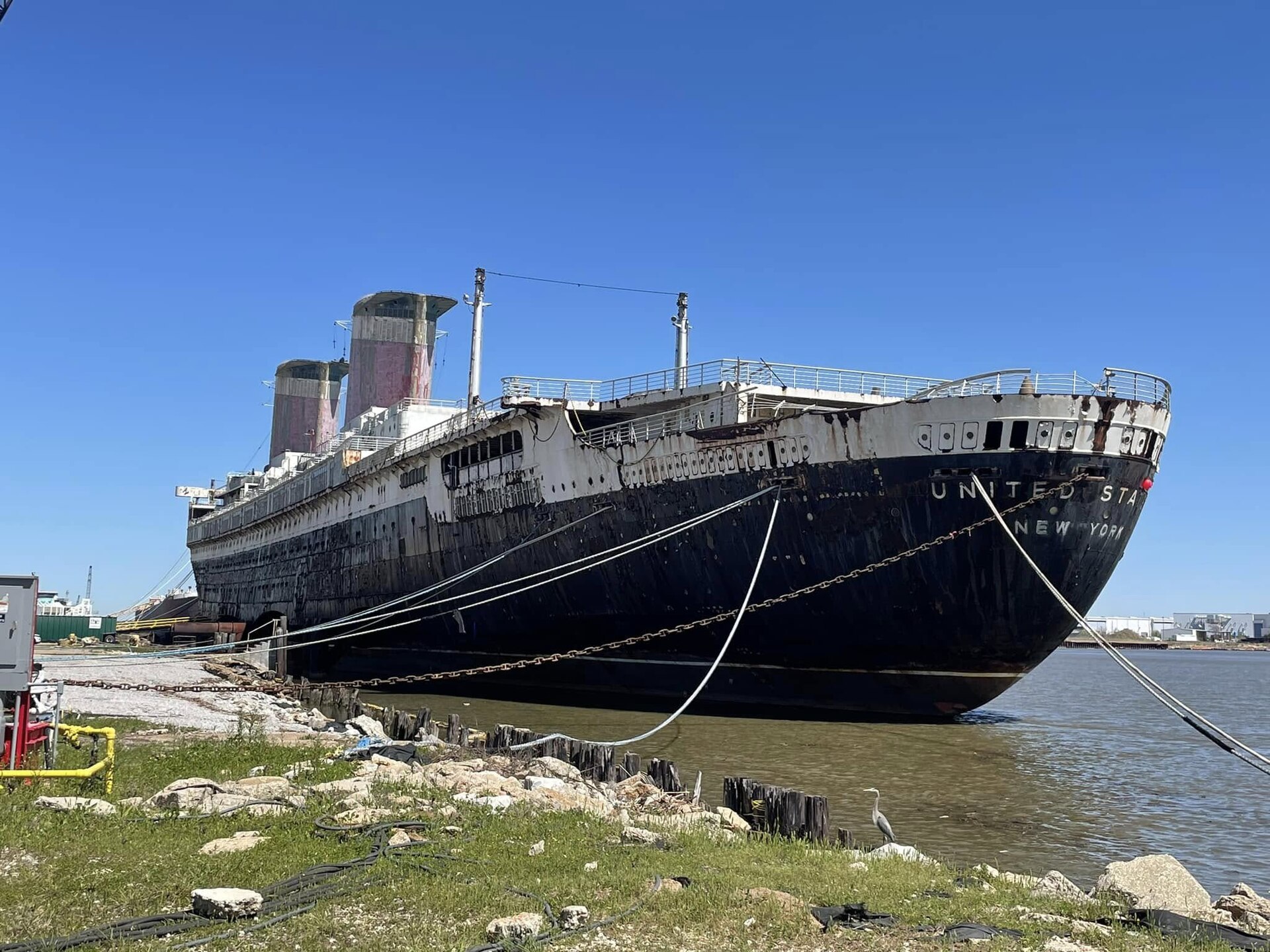
Not with dynamite. According to Baird Maritime, the county’s plans rule out explosives. Here’s what it involves instead, as reported by Baird and Get The Coast:
- Clean it first. The county says all required environmental cleanup is done, following EPA and Maritime Administration best practice for reef vessels. In Mobile, that meant removing hazardous materials (Professional Mariner) and emptying and cleaning the fuel tanks (Get The Coast).
- Make it diver-friendly. Part of the aluminium superstructure is coming off so divers can reach more of the ship at the target depth.
- Cut holes in the right places. A naval architect modelled the ship to decide where the openings go, so she settles upright rather than rolling over.
- Flood the tanks. Get The Coast reports that the cleaned fuel tanks will be filled with water so she goes down in a few hours instead of several days.
- Tow, wait, sink. Get The Coast also reports a tow of about three days from Mobile, then about three days at anchor on site with people aboard and a 24-hour security perimeter.
Why bother at all? Reefs bring divers and anglers, and divers and anglers spend money. The Panhandle already has the proof. In 2006, the aircraft carrier USS Oriskany was sunk about 22.5 nautical miles southeast of Pensacola Pass. “Currently Oriskany holds the largest artificial reef title — we are going to take that title,” Okaloosa’s deputy county administrator, Craig Coffey, told WEAR in April.
The Liner vs. the Carrier
The two wrecks will lie about 12 nautical miles apart (WEAR and the AP both give that figure). Here’s how they compare:
| SS United States | USS Oriskany | |
|---|---|---|
| Length | 990 ft | 911 ft |
| Sunk | Planned for the second week of November 2026 | May 17, 2006 |
| Where | About 22 NM southwest of Destin-Fort Walton Beach | About 22.5 NM southeast of Pensacola Pass |
| Seabed depth | About 180 ft (planned) | About 212 ft |
| Shallowest point | About 55 ft (Baird) or about 60 ft (AP) | 84 ft (top of the island) |
Oriskany figures are from the Florida Fish and Wildlife Conservation Commission. The SS United States figures are the county’s plans as reported by Baird Maritime and the AP, which differ by about five feet on the top deck. We’ll know the real numbers once she’s down.
Not everyone is happy about it. FOX10 says “several groups” still oppose sinking her. What survives above water will go to a land-based museum the Conservancy is planning with the county in Destin-Fort Walton Beach. The Conservancy says it has secured the funnels, the radar mast and the stem anchor.
What It Means for You
- Don’t build a trip around one sinking date. This project has slipped from April to May to June to November in a single year. The county itself says the dates may change. If you want to be on the coast for it, book refundable rooms and flights, or follow online once the Conservancy publishes details.
- Diving her will take real training. The FWC’s advice for the nearby Oriskany is that diving deeper than 100 feet needs advanced training, and below 135 feet needs technical training and special equipment. With the top deck at roughly 55 to 60 feet and the seabed at about 180, how much of the liner you can see depends on your certification. Dive with a local operator and stay within your training.
- Look, don’t take. The FWC also tells divers not to go inside the Oriskany or take anything from it, which it says is against the law. Expect the same rules here.
- Not a diver? Wait for the museum or fish over her. Okaloosa’s tourism director, Jennifer Adams, has said people “will be able to fish on her, spearfish, explore,” as quoted by Billy Penn. We found no opening date for the museum yet.
- If an old ship matters to you, go see it now. Ships don’t last forever, and plenty end up at the breakers rather than in a museum. See our stories on the 1961 liner Funchal and Majesty of the Seas.
The Bottom Line
She beat the Queen Mary across the Atlantic by more than 10 hours. She outlasted decades of rust, several owners and a cruise line’s rescue plan. What finally beat her was a berthing agreement with no end date.
If November’s weather cooperates, the fastest liner ever built will go down in a few hours. She’ll still hold a record: Okaloosa County plans to call her the world’s largest artificial reef.
Cruise Chaos earns nothing from cruise lines and doesn’t run booking affiliate links. The deployment window comes from Okaloosa County’s announcement (via the Destin Chamber and FOX10) and the SS United States Conservancy. The court quotes are from the judge’s opinion and final order on govinfo.gov. Sinking methods, depths and costs come from Baird Maritime, Get The Coast and the AP, and where they disagree we say so. The cost of keeping the ship in Mobile is FOX10’s report, and the six-foot bridge clearance is Billy Penn’s. Oriskany figures are the FWC’s. If we’ve got something wrong, tell us and we’ll correct it in the open.
Coming up on Cruise Chaos: more chaos from the high seas, with every fact checked.
🎁 Get our free Cruise Survival Kit. Join the Cruise Chaos crew and we’ll email you our printable packing checklist and money-saving cheat sheet right away, plus the week’s best cruise stories and verified deals every Friday. Send me the free kit →
Got a cruise story like this?
Something wild, strange or funny happened on your sailing? Tell us what happened. We read every story, fact-check it, and email you before anything is published.
Keep Reading
- Majesty of the Seas Is Still for Sale. One Listing Says Its Toilet Count ‘May Not Be Accurate’
- Party Ship, Floating Hotel, Crypto Dream: The 1961 Liner Funchal Is Sold, and the Buyer Also Scraps Ships
- The Ship Meant for a Three-Year World Cruise Is Being Auctioned for Scrap
Sources
- Destin Chamber: Okaloosa County Sets Timeline for SS United States Deployment as the World’s Largest Artificial Reef (county announcement, October 15, 2026)
- SS United States Conservancy: An Update on the SS United States (October 10, 2026)
- govinfo.gov: Penn Warehousing & Distribution v. SS United States Conservancy, No. 22-2285 (E.D. Pa.), Memorandum Opinion and Final Order, June 14, 2024
- FOX10: Okaloosa County officials announce when SS United States will be deployed (October 10, 2026)
- FOX10: Reef plans for SS United States awaiting USACE approval, officials say (September 2026)
- Professional Mariner: November sinking planned for historic SS United States (October 14, 2026)
- Professional Mariner: SS United States ordered to leave berth by September (June 18, 2024)
- Baird Maritime: Decommissioned ocean liner United States scheduled for reef deployment off Florida in November (October 20, 2026)
- Get The Coast: SS United States set for deployment as world’s largest artificial reef second week of November (October 15, 2026)
- Billy Penn: SS United States gets date for its final voyage to the bottom of Florida’s coast (October 12, 2026)
- Billy Penn: SS United States departure updates (February 2025)
- WMBB via Yahoo News: SS United States towing plans delayed as Coast Guard ensures safe journey (February 2025)
- WEAR: SS United States reef deployment delayed to June amid final preparations (April 17, 2026)
- WHYY (AP): Final resting place set for the historic SS United States (November 18, 2025)
- Cruise Fever: Beloved Cruise Ship Scheduled to Be Sunk Next Month Creating Largest Artificial Reef (October 20, 2026)
- SS United States Conservancy: Why the SS United States Should Matter to You (record and history)
- Florida Fish and Wildlife Conservation Commission: Oriskany artificial reef
- Wikipedia: SS United States (ship specifications and history)
You May Also Like
 Fake ‘Captain Has Lost Control’ Alert: How Six Passengers Got on MSC Divina’s PA
 Banned for Card Counting? The Gambler Suing Royal Caribbean Over Five Free Cruises
 Four Mexican Ports Booked, Ensenada Twice: The Carnival Cruise Two Hurricanes Rewrote
 Majesty of the Seas Is Still for Sale. One Listing Says Its Toilet Count ‘May Not Be Accurate’