
Inside the Real Chaos That Can Erupt at Sea


Cruise ships are designed to feel like floating cities of comfort. Pools shimmer under the sun, buffets never seem to close, and the ocean rolls quietly beneath thousands of relaxed passengers.
Most of the time, that peaceful illusion holds.
But every so often, the ocean reminds everyone onboard who is truly in charge.
When that happens, the calm luxury of a cruise can transform into something far more intense — a mix of confusion, adrenaline, and unforgettable moments that passengers talk about for years.
This is the kind of chaos that rarely makes the brochure.
A Perfect Day at Sea… Until It Wasn’t
The morning started exactly how cruise vacations are supposed to start.
Passengers filled the outdoor decks, coffee cups in hand, watching the sunrise stretch across the open Atlantic. The ship moved steadily through calm water. Staff members prepared breakfast stations while early risers claimed the best loungers by the pool.
Inside the ship’s atrium, live music drifted softly through the multi-story glass interior.
Everything felt routine.
Experienced cruisers know this moment well — that peaceful stretch when a ship is days away from land and everyone begins to fully relax.
But far ahead of the vessel, weather was beginning to change.
And the bridge crew had already noticed.
The Warning Most Passengers Never Hear


Cruise ships operate with extremely advanced navigation systems.
Long before passengers feel anything unusual, the ship’s bridge can detect weather patterns developing hundreds of miles away. Radar, satellite data, and maritime forecasts allow captains to adjust course to avoid storms.
But sometimes the ocean moves faster than expected.
On this particular voyage, the weather system intensified far quicker than forecast models predicted.
The captain had already altered course slightly — a normal adjustment most passengers never notice.
Yet the ocean was beginning to build energy.
Wind speeds rose. Waves grew taller. Pressure dropped.
Down on Deck 12, passengers lounging by the pool had no idea that the bridge was now carefully monitoring the ship’s movement every few seconds.
The First Sign Something Was Wrong
It began with a simple shift.
Not a violent motion. Just enough to make people pause.
A glass slid slightly across a table in the outdoor café. A pool chair tipped sideways. Some passengers felt a gentle sway that seemed stronger than before.
Cruise ships move constantly, but seasoned travelers recognize when the motion changes.
Within minutes, the waves grew larger.
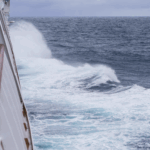
Water began splashing over the forward deck as the ship pushed through rising swells.
Crew members quietly began securing outdoor furniture — another sign experienced cruisers recognize immediately.
Something was changing.
When the Ocean Takes Over


Then the real motion began.
The ship climbed a large wave.
For a moment it felt like an elevator rising slowly.
Then the vessel dropped down the other side.
A few passengers gasped. Plates rattled in the buffet area. A couple of drinks spilled at the bar.
Crew members moved quickly to secure loose equipment.
The ship’s stabilizers — massive underwater fins designed to reduce rocking — activated fully to counter the increasing waves.
But the ocean kept building.
Soon the ship was rolling more dramatically, and the once-relaxed passengers now held onto railings as they walked the corridors.
Elevators filled with people laughing nervously.
This was no longer the calm vacation day everyone expected.
Inside the Ship During a Storm
Cruise ships are designed to handle far worse conditions than most passengers ever experience.
Still, when the sea becomes rough, the environment inside the vessel changes quickly.
Restaurants suddenly feel quieter.
Pools are closed.
Deck access may be restricted for safety.
Crew announcements politely ask passengers to avoid open decks and use handrails while moving around the ship.
The mood shifts.
Some passengers find the experience exciting.
Others retreat to their cabins, watching waves crash against their balcony doors.
For many travelers, this is their first time truly feeling the power of the open ocean.
The Moment Chaos Spread Through the Ship


As the waves intensified, the ship rolled more noticeably.
In one dining area, glasses slid slowly across a table before falling to the floor. A few chairs tipped sideways. Staff rushed to secure everything.
Passengers walking through the atrium grabbed railings as the ship leaned gently to one side.
In the theater, a scheduled performance was delayed while technicians secured lighting equipment.
Nothing catastrophic happened.
But the ship felt alive — moving, reacting, responding to forces far bigger than itself.
For many passengers, this was the moment they realized cruising is not just about luxury.
It is about navigating one of the most unpredictable environments on Earth.
How Cruise Ships Are Built to Survive Chaos
Modern cruise ships are engineering marvels.
They are specifically designed to withstand enormous ocean forces while maintaining passenger safety.
Some key safety features include:
Stabilizer fins
Massive underwater wings extend from the hull to counteract rolling motion.
Watertight compartments
Ships are divided into sealed sections that prevent flooding from spreading.
Advanced radar systems
Weather tracking allows captains to avoid the most dangerous conditions.
Dynamic positioning and propulsion control
Multiple engines and thrusters allow precise adjustments even in rough seas.
Even when passengers feel dramatic motion, the vessel itself is operating well within safe limits.
The sensation of chaos is often far greater than the actual risk.
When Calm Finally Returns
Hours later, the storm began to weaken.
The ship slowly entered calmer waters.
Movement eased. The horizon stabilized. Conversations returned to normal levels in restaurants and lounges.
By evening, many passengers were already laughing about the experience.
The buffet reopened.
Music returned to the atrium.
And the ocean once again looked peaceful.
Yet those who experienced the storm would never forget it.
Because moments like that reveal the hidden side of cruising — the side rarely shown in travel ads.
Why Cruise Chaos Fascinates Travelers
There is something strangely captivating about moments like these.
Cruise vacations promise comfort, but the ocean always adds an element of unpredictability.
That unpredictability creates stories.
Stories about sudden storms.
Stories about unexpected ship motion.
Stories about how thousands of people react when the sea decides to put on a show.
For some travelers, those chaotic moments become the most memorable part of the entire voyage.
They remind us that despite all the luxury onboard, we are still guests on the ocean.
And the ocean always has the final word.
The Truth About Chaos at Sea
Most cruise voyages are calm and uneventful.
But every so often, the ocean delivers a reminder of its immense power.
When it does, cruise ships prove exactly what they were designed to do: protect passengers while navigating one of the most powerful environments on the planet.
Those moments may feel chaotic.
But they also reveal something remarkable.
A floating city, thousands of people, and a crew working quietly behind the scenes — all moving together through a restless ocean.
And for passengers lucky enough to witness it, the experience becomes a story they will tell for years.